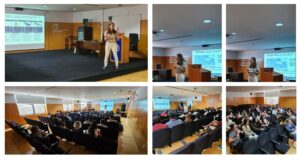




Last Friday, November 7th, the Lecture Hall at the Faculty of Economics, Business and Tourism (FEET) hosted the lecture “Artificial Intelligence and Sustainability: Are They Compatible?”, delivered by Julia Martínez Cabrera, PhD candidate in Circular Economy at the faculty. Martínez Cabrera holds a Master’s degree from HEC Paris in Sustainability and Social Innovation, where she also teaches as a visiting lecturer, is the academic director of the Circular Tourism programme at ULPGC, an external consultant for the United Nations Economic Commission for Europe (UNECE), and a member of the non-profit
organisation Circular Munich (Germany).
During her talk, she reflected on the enormous potential of artificial intelligence (AI) to accelerate the Sustainable Development Goals, while also addressing the environmental impacts associated with its use: energy, water, and material consumption, as well as the growing carbon footprint of data centres, which already account for around 1.5% of global electricity demand.
The speaker stressed the importance of encouraging responsible use of generative AI — such as ChatGPT — noting that each digital interaction has a measurable environmental impact. In this regard, she presented tools such as comparIA (developed by the French Government), which enable assessing and comparing the ecological footprints of different generative AI models, illustrating how larger models — although more powerful — are also more energy-intensive and have a higher carbon footprint.
Towards the end of the lecture, Martínez Cabrera encouraged students to “choose the right amount of intelligence” for each task, prioritising technological solutions with a lower impact. In the subsequent practical workshop, participants applied this criterion by selecting appropriate AI models based on the problem type.
The FEET would like to thank Julia Martínez Cabrera for this inspiring session, which helped students gain a deeper understanding of how to balance technological innovation and sustainability, and how to incorporate responsibility criteria into the use of AI.