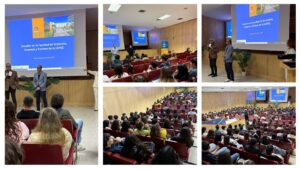
On Thursday, 12 March, the University of Las Palmas de Gran Canaria (ULPGC) held its Open Days in both morning and afternoon sessions. The event is primarily aimed at second-year upper secondary school students and Higher Vocational Training students, but is also open to parents and anyone
interested in learning more about the University.
The morning session was streamed live online and was opened by the Rector and the Vice-Rector for Students of ULPGC. In their welcome remarks, they encouraged the many students in attendance to choose ULPGC and highlighted the quality of its teaching staff and degree programmes, as well as the advantages of studying at the Tafira Campus, which offers an excellent academic environment and a wide range of services, including the university library and the Student House.
The Dean of the Faculty of Economics, Business and Tourism then presented the Faculty’s degree programmes, explaining their key features, career prospects, and the double-degree options available. She also highlighted international mobility opportunities, including the possibility of pursuing double degrees abroad. Students were also informed about the Faculty’s mentoring programme, which supports new students during their first weeks, and about the course “Train in Mathematics for Economics and Business”, designed to help students strengthen their mathematical background.
The session concluded with two students, Irene Lorenzo García and Adrián Martínez Castro, who are finalists in the 2025 Economics Olympiad and are currently studying the Double Degree in Business Administration and Tourism, sharing their positive experience of participating in the competition.
Both sessions were held in the Assembly Hall and attended by a large number of students. Representatives of the Student Delegation also collaborated in the event by guiding visitors on a tour of the Faculty’s buildings and facilities.

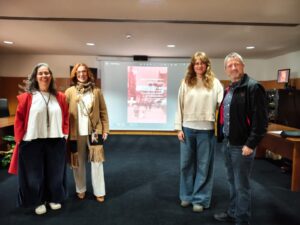
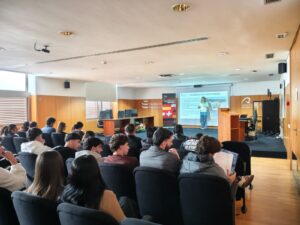
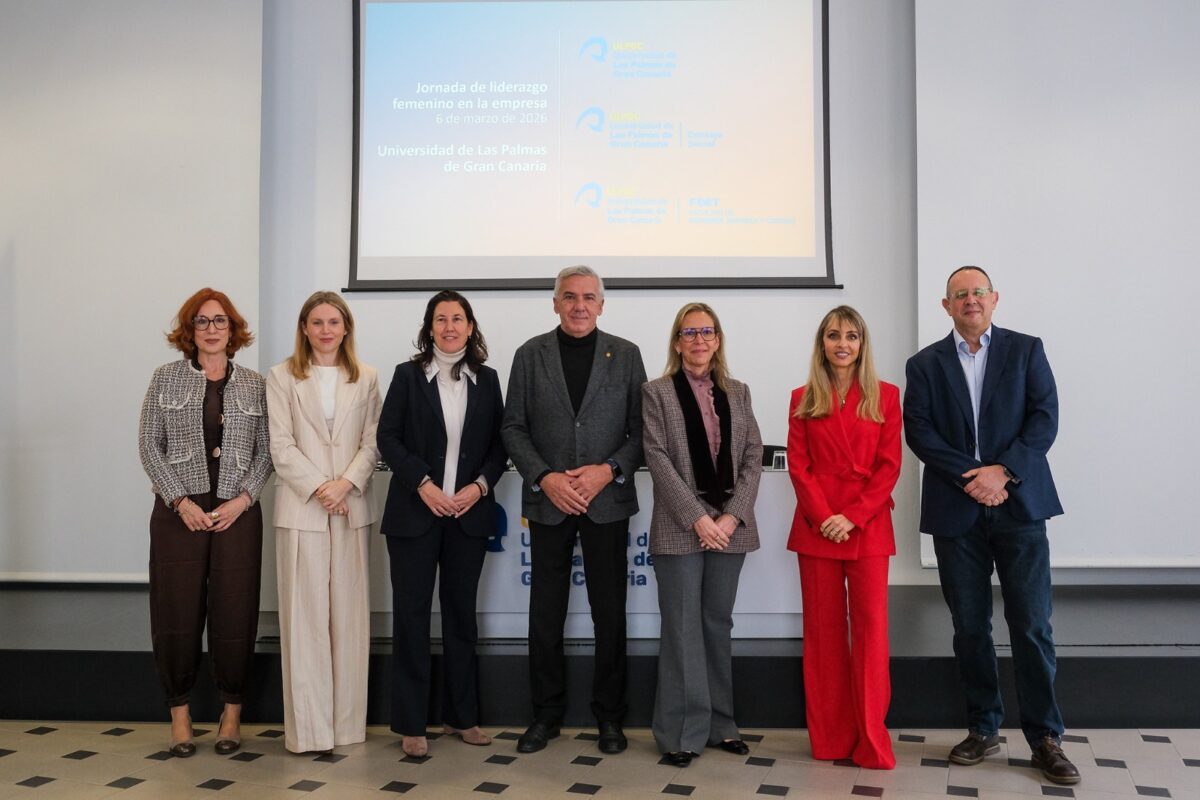
Last Friday, March 6, a Workshop on Female Leadership in Business was held in the Aula de Piedra of the Rectorate’s institutional building at the University of Las Palmas de Gran Canaria (ULPGC).
The event served as a meeting point for academia, public administrations, and the business ecosystem to foster discussion among them. The aim was to identify factors that can encourage women’s access to positions of responsibility, thereby promoting business growth and sustainability in the Canary Islands.
The workshop was organized by the Social Council of the ULPGC, the Faculty of Economics, Business and Tourism, and the ULPGC Equality Office.
During the event, ULPGC Professor Domingo Javier Santana Martín presented data on the situation of women in leadership positions in European companies. Professor Emma García Meca, from the Technical University of Cartagena, explained, using scientific evidence, the relationship between business leadership and various aspects of corporate behavior.
This was followed by the roundtable discussion “Challenges and Opportunities for Women Leaders,” which featured Ana Suárez Calvo, entrepreneur and President of the ULPGC Social Council; María Victoria Ruíz Mallorquí, Dean of the Faculty of Economics, Business and Tourism at ULPGC; Emma García Meca, Professor at the Technical University of Cartagena; Laura García Vera, Regional Director of Bankinter in the Canary Islands; and Susana del Castillo Bello, Investment Director at Casticapital and Independent Board Member of Sacyr.
We would like to thank all attendees for their interest in the event and for enriching the discussion through their many contributions.

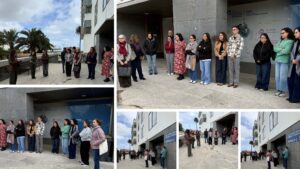
On March 6, Vice-Dean Carmen García Galindo read the CRUE manifesto to commemorate International Women’s Day, under the UN Women slogan: “Rights. Justice. Action for ALL women and girls.”
The manifesto states the following:
The slogan “Rights. Justice. Action for ALL women and girls” challenges our institutions, whose mission is to generate, transmit, and apply knowledge through research, teaching, and knowledge transfer.
In the university sphere, defending women’s rights means guaranteeing their full participation in academic, scientific, and professional life, without barriers, gaps, or discrimination. It means promoting safe environments free from harassment and violence, and making equal opportunities a real and
effective principle, beyond a mere formal declaration.
Justice requires us to analyze reality through a gender lens and act accordingly. Despite the progress achieved and the women who have paved the way in academic and scientific fields, gaps and obstacles persist that limit women’s progress in research careers on equal terms and hinder their access to decision-making and leadership spaces. Correcting these inequalities is not a symbolic issue. It is a matter of justice that strengthens the quality, excellence, and integrity of university action. Universities cannot be fully just while part of their talent remains invisible and underrepresented.
Action implies courage, responsibility, coherence, and sustained commitment. It means moving from words to deeds by consolidating and evaluating equality policies, supporting the development of female scientific vocations, and eliminating structural biases that continue to affect the evaluation, funding, and recognition of women’s merit. It also means strengthening cooperation among universities, public administrations, the productive sector, and civil society to build a more inclusive and equitable educational and scientific ecosystem.
On this International Women’s Day 2026, the Conference of Rectors of Spanish Universities (CRUE) reaffirms its commitment to a university free from inequality, diverse in its leadership, co-responsible in care, and exemplary in the active defense of human rights.
From here, we urge everyone to actively advocate for rights, justice, and action for ALL women and girls. We especially call on those who study, research, teach, and work in our universities to lead by example. Every member of the university community is called upon to take responsibility and work together to transform our institutions into lasting spaces of equality and progress.
The reading was attended by students, faculty members, and members of the PTGAS (Technical, Management, and Administrative and Service Staff).